Coca Cola
The Coca Cola appears only once in the narrative, but its brief presence carries an outsized emotional weight. It is a relic of the vanished world, a manufactured sweetness that survives the apocalypse by chance, and its discovery becomes one of the few moments of unalloyed joy in the man and the boy's journey south. The can is not merely a drink; it is a token of the father's love, a fleeting gift of the old world's comforts, and a reminder of what has been lost.
Discovery in the Gutted Machine
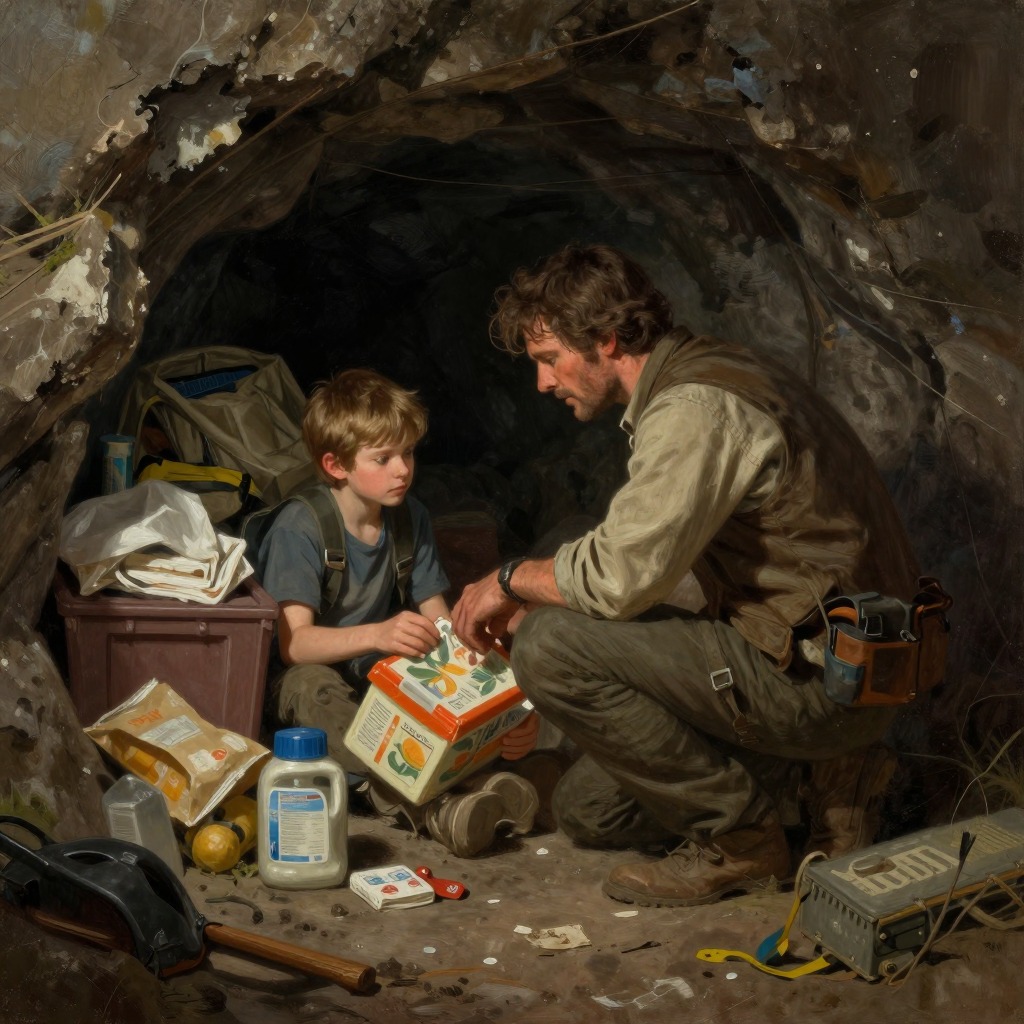
The Coca Cola is found in the outskirts of a city, in the alleyway behind a supermarket. The man and the boy have been scavenging through the littered aisles, finding only a few ancient runner beans and dried apricots in the produce bins. They push out through the rear door and find a few rusted shopping carts, but no usable cart. By the door are two softdrink machines that have been tilted over into the floor and opened with a prybar, their coins scattered everywhere in the ash. The man sits and runs his hand around in the works of the gutted machines, and in the second one his hand closes over a cold metal cylinder. He withdraws it slowly and sits looking at a Coca Cola. The boy asks what it is, and the man calls it a treat, for him.
The Ritual of Sharing
The man slips the boy's knapsack straps loose and sets the pack on the floor behind him. He puts his thumbnail under the aluminum clip on the top of the can and opens it, leaning his nose to the slight fizz coming from the can before handing it to the boy. The boy takes the can, notes that it's bubbly, and then drinks. He sits there thinking about it, and declares it really good. The man sips it and hands it back, telling the boy to drink it. The boy, perceptive beyond his years, asks, "It's because I wont ever get to drink another one, isnt it?" The man replies, "Ever's a long time," and the boy accepts this with a simple "Okay." This exchange encapsulates the boy's growing awareness of mortality and the scarcity of all things, even as the man tries to soften the truth.
A Symbol of the Lost World
The Coca Cola is one of the few manufactured goods that still retains its original form and taste in the ashen world. It stands in stark contrast to the dried, shriveled, and rusted remnants of food they usually find. The can's cold metal, its fizz, and its sweetness are all echoes of a time when such things were commonplace. The man's careful handling of the can—opening it with his thumbnail, savoring the fizz—shows his reverence for this small miracle. The boy's question about never drinking another one reveals the profound loss that defines their existence: every pleasure is singular, every object is the last of its kind. The Coca Cola thus becomes a microcosm of the novel's central theme: the frailty of everything and the last instance of a thing taking the class with it.
Connections to Other Relics
The Coca Cola is not the only relic of the old world that the man and boy encounter. They find a sextant on the ship, a brass instrument of great beauty that stirs the man, and they drink Coca Cola again in the bunker, where they find a supply of it among the canned goods. In the bunker, they sit on a cot with a checkerboard between them, wearing new sweaters and socks, and drink Coca Cola out of plastic mugs. This second appearance is a stark contrast: here, the Coca Cola is abundant, part of a hoard that allows them to eat and drink their fill. Yet even this abundance is temporary, and the man knows they cannot stay. The Coca Cola, whether a single can or a case, always carries the weight of its own scarcity and the inevitability of its consumption.
The Coca Cola also resonates with other moments of shared sweetness, such as the morels they find and cook, or the apples they eat in the pine wood. These are all gifts of the earth or of chance, and they are all consumed with a reverence that borders on the sacred. The Coca Cola, however, is unique in being a purely manufactured item, a product of the industrial world that has survived the collapse. Its presence is a reminder that even in the ruins, some things endure, and that the simple pleasures of the past can still be tasted, if only once.